
Letter from the President: A solid year for SFM

Terry Miller
SFM President and CEO Terry Miller

Despite continued pressure from other carriers and mixed claims results, SFM again had a successful year in 2025.

Being the leaders in workers’ compensation means striving to provide unparalleled service, working to keep employees safe and helping clients reduce their experience modification factor. We do that through our dedication to customer service – building and maintaining relationships with agencies and ensuring policyholders get everything they need from their work comp partner.

A few notable highlights from the past year include:

  • Surpassing $1 billion in assets
  • Upgrading our internal systems to better serve agents and policyholders
  • Developing enhanced systems for agents to get quotes faster
  • Improving claims handling in core and non-core states

Service excellence is the foundation that supports our success. That philosophy helps us retain policyholders, generate new business and build agency relationships now and in the future.

Additional highlights from 2025 include:

  • SFM’s policyholder retention level of 93%, demonstrating our industry-leading customer loyalty
  • Continued growth in our newer markets, particularly Indiana and Tennessee
  • A banner year for new premium in Wisconsin
  • Policyholder surplus growth larger than premium growth
  • Projects to enhance our online portals – the SFM Agency Manager (SAM) and MyPayroll premium audit process – to make our systems more intuitive and user-friendly

Another item I’d like to share from last year was the promotion of Amanda Aponte to Executive Vice President.

She has been an integral part of SFM’s growth during her two decades with us. She has helped guide our investment strategy, bolster our enterprise risk management processes, and perform insightful business intelligence analysis.

Amanda, who started as an intern at SFM, is a sterling example of what can happen when we give people the space to fulfill their potential. Her financial acumen and vision have been critical to SFM’s success, and her leadership will help position us for the future.

As we move into the new year, we want our agent partners to know how much we appreciate their trust. Let’s continue to write more business and build on the momentum we’ve generated over the years. When you select SFM for your policyholders’ work comp coverage, we understand you are choosing to resist pressure from package insurance lines and recognize the value of our dedication and service.

SFM realizes that strong financial results are necessary for the success of our stakeholders. We also know our staunch commitment to focusing on our customers is the backbone of what we do and how we will continue to grow moving forward together.

Thank you for your continued support and partnership! We look forward to sharing success with you and your clients for many years to come.
 

Read more Agent Agenda articles

2025 results: Success built on customer service

Building on its status as the No. 1 workers’ compensation carrier in Minnesota, SFM had another strong year in 2025, with gains in newer markets, as well.

“About half of SFM’s business is now from states outside of Minnesota,” said Shawn Miner, VP of Regional Business. “In addition to maintaining the lead we’ve held in Minnesota for over 20 years, it’s fantastic to see strong growth coming from our other core states.”

Also of note, in 2025 SFM moved claims handling in-house in Indiana and Tennessee, which is expected to provide better service for policyholders and bolster SFM’s reputation in these states. This change allowed SFM to increase its appetite and write business for accounts larger than $25,000 in Indiana and Tennessee.

“We’re excited to add employees in our newer states as our footprint continues to grow,” said Cody Allen, SFM Territory Manager. “With claims handling coming in-house and our standing in new core states expanding, we are looking forward to increasing our presence and, in turn, our market share.”

Wisconsin, specifically, had an excellent 2025, with a record for new business premium.

“Our passion for providing the best work comp service is resonating with agents and policyholders,” said Rick Spaulding, a Wisconsin Team Business Leader. “They invest in a relationship built on trust.”

Highlights from 2025 include:

  • 93% policyholder retention rate
  • Total written premium of just over $253 million for 2025
  • New business premium of $28.4 million
  • Added 6,071 new business policyholders
  • Another year of an A- rating from AM Best
  • SFM Foundation awarded 19 new scholarships, bringing the total to $4.7 million
  • Ongoing member of Keystone Program, donating 2% of pre-tax profits to charity

SFM partners with thousands of independent agents and serves more than 50,000 policyholders. In addition, SFM’s portion of the Wisconsin Workers’ Compensation Assigned Risk Plan is increasing from 20% to 25% this year.

“We have seen steady growth, despite rising claims and medical costs, and our overall trajectory is strong,” Steve Sandilla, Senior VP and Chief Business Officer. “While we have long been a work comp leader in the Midwest, the success of this latest round of expansion is a sign that we will continue to capture more market share in the years to come.”


Read more Agent Agenda articles

SFM’s top class codes

We have worked to make SFM Agency Manager (SAM) as easy to use as possible, including streamlining the underwriting process.

SFM writes business in more than 400 class codes – key industries such as construction, healthcare, manufacturing, hospitality, social services and nearly any other “main street” business you can think of.

The following lists of our top 20 new business class codes by policy count and premium will give you an idea of where we’re seeing the most success.

Top 20 class codes by policy count

This shows SFM’s top new business class codes by policy count over the past three years.

  1. 5645 – Carpentry – Resident Dwelling
  2. 8835 – Home, Public & Traveling Healthcare
  3. 8810 – Clerical Office Employees NOC
  4. 8868 – Colleges Or Schools 
  5. 9015 – Bldg or Prop M – Ops By Owner
  6. 8842 – Group Homes – All Employees
  7. 9082 – Restaurant NOC
  8. 5474 – Painting Or Paper Hanging NOC
  9. 8017 – Store Risks Retail NOC
  10. 8832 – Physicians 
  11. 0006 – Farms No Inservants
  12. 9084 – Bar, Discotheque, Lounge, Nightclub
  13. 0037 – Farm NOC
  14. 8742 – Salespersons Or Messeng-Outsid
  15. 8380 – Automobile Service Or Repair
  16. 9063 – YMCA, YWCA, YMHA Or YWHA
  17. 9014 – Buildings Operation By Contractors
  18. 8869 – Child Day Care Center – Professionals
  19. 8824 – Group Homes – All Employees
  20. 5190 – Electrical Wiring-Within Buildings

Top 20 class codes by premium

This shows our top new business class codes by premium size over the past three years.

  1. 8868 – Colleges Or Schools
  2. 8824 – Retirement Living Centers Healthcare
  3. 8842 – Group Homes – All Employees
  4. 8835 – Home, Public & Traveling Healthcare
  5. 5645 – Carpentry – Resident Dwelling
  6. 8833 – Hospitals Professional Employes
  7. 8832 – Physicians 
  8. 7382 – Bus Co: All Other Employees & Drivers
  9. 8829 – Nursing Or Convalescent Home
  10. 0006 – Farms No Inservants
  11. 9082 – Restaurant NOC
  12. 8864 – Social Service Organization
  13. 7219 – Trucking NOC
  14. 5221 – Concrete or Cement Work-Floors
  15. 8380 – Automobile Service Or Repair
  16. 9012 – Building or Property Mgmt-C&S
  17. 0037 – Farm NOC
  18. 3632 – Machine Shops NOC
  19. 8017 – Store Risks Retail NOC
  20. 9015 – Bldg or Prop M – Ops By Owner


Read more Agent Agenda articles

SFM continues to enhance claims handling

It was a busy 2025 for SFM in terms of claims handling.

At the beginning of May, SFM began addressing Indiana claims internally rather than through a third-party administrator. The change did not impact how policyholders report injuries, but is aimed at improving the experience for injured workers by utilizing SFM’s claims expertise.

“SFM is known for its outstanding capability in claims handling. By taking on these claims in-house, we can provide a higher level of customer service and a better experience for policyholders and injured workers,” said Angie Andresen, Vice President of Claims.

That change coincided with expanding SFM’s book of business in Indiana and opened the door to write policies for accounts larger than $25,000 in annual premium.

A similar change was made in December for claims in Tennessee. SFM is now handling those claims directly and also began writing business with mid-market employers in the state.

“Our relationships with agency partners in our newer states continue to build with each passing year,” said Mike Happe, Senior Vice President and Chief Marketing Officer. “SFM’s standing as the work comp experts has helped us develop, retain and grow business in these markets, and we’re excited to handle claims ourselves and expand our book of business in these states.”

New claims handling in non-core states

SFM in 2025 also changed its third-party administrator (TPA) for claims handling in non-core states to CBCS .

The company began handling claims in SFM’s non-core states beginning in December 2025. CBCS’ approach is similar to SFM’s — a focus on customer service and doing right by both policyholders and injured workers. The company boasts a 99% client retention rate over the past decade and is committed to the client experience.

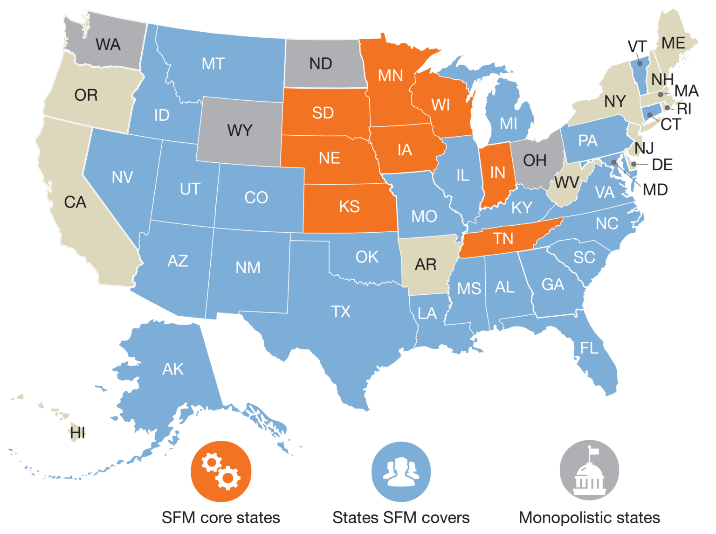
As a refresher, SFM’s core states include:

  • Minnesota
  • Wisconsin
  • Iowa
  • Nebraska
  • South Dakota
  • Indiana
  • Tennessee
  • Kansas

“We put a great deal of thought into making the decision to change our TPA for claims handling in non-core states,” said Sarah Hunter, VP Operations. “SFM conducted extensive research before landing on CBCS as the best claims partner for us moving forward.”

SFM alerted policyholders with legacy claims about the change, and CBCS reached out to injured workers on all applicable open claims and provide new claim and contact information.

“We’re excited to partner with a company that shares SFM’s commitment to service excellence,” Andresen said.

SFM territory map


Read more Agent Agenda articles

Remind policyholders: winter safety must continue

It’s that time of year again…

With winter in full swing — and the upcoming thawing and refreezing cycles in the months ahead — workplace safety should be paramount.

Be sure to remind your policyholders that just because spring is on the horizon, it doesn’t mean they can be any less vigilant about workplace safety.

Slips, trips and falls – the bottom line

Slips, trips and falls are a leading cause of workplace injury. They can be severe, leading to fractures, head trauma or worse.

The costs of covering these claims gets expensive. Not only can it negatively influence the employer’s experience modification factor, but it also impacts agency and carrier results. SFM estimates the average winter slip-and-fall lost-time claim to be between $50,000 and $55,000.

Weather is a major factor in workers’ compensation. Slipping and falling because of snow and ice is one of the most common workplace injuries.

Resources for policyholders

With a few reminders and some common sense, policyholders can help employees stay safe and reduce the potential for claims.

A few basic tips for you to pass along include:

  • Properly maintain your parking lot and walking areas
  • Encourage employees to wear appropriate shoes for the weather
  • In the case of a snowstorm, let employees work from home or reschedule if possible
  • Manage snow piles near walkways to avoid melting snow refreezing to ice

Policyholders should educate their employees about other winter safety measures, such as walking like a penguin, salting slippery areas, avoiding shortcuts, and stepping down, not out, of vehicles.

If you are looking for additional resources to help in these efforts, check out what’s available on our website or contact your underwriter.


View more Agent Agenda articles

Underwriter accomplishments: Second half of 2025

Here’s a look at the latest promotions and accomplishments for SFM’s underwriting staff over the past several months.

  • Tamara Flanagan was promoted to Underwriting Technical Support Representative and transferred to the Underwriting Tech team.
  • Tracy Johnson was promoted to Senior Underwriter.
  • Janice Fisher joined SFM as a Marketing Underwriter on the Iowa/Nebraska/Kansas Accounts team.
  • Alex Johannes joined SFM as a Marketing Underwriter on the South/Metro Accounts team.

Also of note for SFM in 2025:

  • Shannon Nelson joined SFM as Senior Defense Counsel with Schmidt, Scharfenberg & Hollick.
  • Executive Services welcomed Associate General Counsel John Marsalek.
  • Colton White joined SFM as a Business Development Rep for Indiana agencies.
  • Former company President and CEO Pat Johnson was inducted into the Minnesota Insurance Hall of Fame.


Read more Agent Agenda articles

Prevent litigation, stay in contact with injured employees

Prepared by SFM’s in-house legal team

Many litigated workers’ compensation claims could have been avoided if the employer had simply shown concern for the employee’s welfare early on.

When an injured worker hears nothing from their employer, they get the impression nobody cares.

Often, litigation is a reflection of feeling ignored—if the employer won’t make time to listen, an attorney will.

Show concern right away

As soon as you learn of an injury, have your claims coordinator, risk manager, or the employee’s supervisor follow up. If the employee is off work, call them at home or visit in person if appropriate.

Some supervisors avoid reaching out because they worry about saying the wrong thing. But saying nothing is a sure way to deliver the wrong message. Set up a regular check-in schedule.

What to say when you reach out to injured workers

Injured workers worry about their jobs and livelihood. Reassure them that you’re looking forward to their return and will have a position for them when they’ve recovered.

Let them know you’ll provide work or accommodations so they can return as soon as medically possible — even if that means a different role based on their restrictions.

This matters more than you might think: fear of losing their job or income is one of the most common reasons injured employees decide to hire an attorney.

Stay professional during disputes

If a benefit dispute arises and you attend hearings or proceedings, remain civil and respectful — even if relations are strained. If the employee is still actively employed, walk over to greet them and their family. It signals that the dispute is “just business,” not personal.

Train your supervisors to separate personal feelings from any disputes that come up along the way.

Be ready for their questions

Injured employees will have questions about workers’ compensation and employee benefits. Be prepared to review your company’s policies and direct them to their claims representative for detailed benefits or claim questions. If the claim is denied or disputed, discuss other benefits they may be eligible for either separately or concurrently, including short-term disability, long-term disability, or paid or unpaid leave, such as FMLA.

Review policies on health insurance continuation. When you’re the one answering their questions, they’re less likely to seek outside sources prematurely.

Take work restrictions and retaliation concerns seriously

Staying in contact remains important even after the employee returns to work.

If the employee or coworkers raise concerns about return-to-work issues, respond promptly. Be alert to any perception of retaliation or discrimination — don’t ignore these concerns.

If supervisors or coworkers report that the employee is working outside their medical restrictions, address it immediately. Emphasize the need to work safely within restrictions. If the employee continues to disregard instructions, you may treat it as a performance or safety issue. While you cannot retaliate against an employee for having a work injury, you can enforce reasonable safety expectations.

If the employee complains that the supervisors or coworkers require the employee to work outside of restrictions, or retaliate when he or she declines to perform duties outside of restrictions, investigate those concerns. If the investigation suggests this is occurring, discipline or write up the supervisor or coworker if the behavior continues.

The bottom line

Work injuries can generate bad feelings or goodwill. Your care, concern, and attention throughout an injured worker’s recovery can prevent unnecessary conflict—and costly litigation.

For more information on what to do after an employee is injured, see these additional SFM resources:

This content is provided for general informational and educational purposes only and is not intended as legal advice for specific situations or as a legal basis for your employment practices. For guidance on particular circumstances, consult with qualified legal counsel.


Originally published in December 2018; updated in January 2026

SFM Foundation scholarship applications accepted until March 31

The SFM Foundation will be accepting scholarship applications for the 2026-27 academic year until March 31, 2026.

The nonprofit makes college more affordable for families affected by workplace injuries by offering post-secondary education scholarships to children of parents fatally or seriously injured on the job while working for a Minnesota or Iowa employer.

Scholarships may be used toward the costs of attending a two- or four-year university, college, vocational school or graduate school. To qualify, students must have a parent who was disabled or fatally injured while working for Minnesota or Iowa employers. Scholarships are awarded up to a maximum of $15,000 a year.

Interested applicants can find a registration form and additional eligibility requirements for the scholarships on the SFM Foundation website .

Scholarships will be awarded based on injury severity and impact on the student and their family, among other factors.

About the SFM Foundation

The SFM Foundation was created in 2008 by SFM Companies, a regional workers’ compensation insurance group headquartered in Bloomington, Minn. The nonprofit is dedicated to easing the burdens on families affected by workplace accidents. Since its inception, the foundation has awarded 266 scholarships totaling $4.7 million. For more information, visit sfmfoundation.com .

The SFM Foundation is an affiliate of Kids’ Chance of America in Iowa and Minnesota.


View more news about SFM

Subrogation: When third parties bear responsibility for work injuries

By Tom Davern, Esq., Senior Defense Counsel with SFM’s in-house law firm, and Julie Bischoff, Senior Subrogation and Special Investigations Representative

When one of your employees is injured in the course and scope of employment and a negligent third party bears some responsibility, we can sometimes recover a portion or all of the workers’ compensation claim costs from the responsible party through subrogation.

Each of SFM’s core states have different workers’ compensation subrogation laws, but the basic principles are the same across the board. If a third party’s negligence causes a work injury to some significant degree, there is a possible subrogation claim. The employer and insurer have to prove negligence, causation and damages.

When we recover claim costs, it lowers the impact that the claim has on future workers’ compensation premiums by mitigating the hit to the employer’s experience modification factor (e-mod). In 2025, our Subrogation Team recovered more than $1.8 million. In many cases, SFM recovers 100% of what was paid on the claim.

In fact, full recovery was received on more than 50% of the subrogation claims in 2025. A complete recovery is most likely when there is no liability dispute and the injury is not serious enough to allow or motivate an employee to pursue a personal injury claim. If the employee pursues a claim for damages against the third party, it usually results in a partial recovery for the employer and insurer.

Common recovery scenarios

Motor vehicle accidents, slip-and-fall injuries and dog bites are just three types of claims in which we can often make subrogation recoveries.

For example, if a pizza delivery driver is hit by a drunk driver, we may be able to recover the workers’ compensation benefits paid from the at-fault driver’s insurer.

If there is provable negligence, slip-and-fall claims can result in a subrogation recovery. However, these have to be carefully analyzed on a case-by-case basis. There is not going to be a viable claim if a slip and fall happened in a parking lot during a blizzard, but if a vendor spilled oil in a hallway and failed to clean it up, there may be a claim.

If a dog bites a home health care worker or delivery person at a customer’s home, we may be able to recover costs from the individual’s homeowners or rental insurance policy. SFM also pursues product liability claims, medical malpractice, restitution in criminal matters and other general liability claims.

How employers can help

If you have a claim that has recovery potential, your claims representative or someone from our Subrogation Team may reach out for assistance in the investigation. It is helpful to gather and preserve any available evidence in cases that may have recovery potential.

Anytime you think a third party could be responsible for a work injury, let your claims representative know. SFM aggressively pursues recoveries on behalf of our policyholders when another party is at fault.

Common requests for subrogation claims

  • Motor vehicle accident: Police report, photographs of the property damage or scene, third-party driver/insurance information, and video of the incident (if available)
  • Dog bites: Name and address of the dog owner, photographs of injury, and police or incident report
  • Slip, trip and fall: Photographs of the area of the fall, any available video (we also recommend reporting the incident to the property owner), and witness information
  • Assault: Whether criminal charges were filed, and if so, the name of the assailant
  • Product liability claims: Secure the product and provide owner manuals, maintenance records, purchase receipts and manufacturer information (for equipment malfunctions, we recommend also taking photos and keeping any broken equipment)


Originally published April 2021; updated January 2026.

css.php