How to prevent eye injuries in the workplace

An estimated 2,000 eye injuries happen every day in workplaces across the United States. According to the Occupational Safety and Health Administration, workplace eye injuries have a yearly cost of $300 million in lost production time, medical expenses and workers’ compensation costs.

What to watch out for

Nearly 70 percent of eye-related accidents result from flying and falling objects or sparks striking the eye. Particles such as dust, cement chips, metal slivers and wood chips can be sent flying following the use of a tool, or else can be blown into the eye by the wind or fall from above a worker.

Other dangers include penetration from sharp objects, such as nails, staples or slivers of wood, and exposure to chemicals.

Before removing eye protection, brush any particles out of your hair and eyebrows that may have gotten trapped while you were performing the job.

It’s also important to maintain your eyewear. Dirt and scratches can reduce vision, cause glare and may not offer full protection.

What eyewear should you use?

There are several kinds of eyewear that offer different protection. Make sure to use eyewear that is appropriate for the job:

  • Side shields are required when there are flying particles
  • Face shields are required when grinding, welding or removing slag
  • Splash goggles or face shields are required when pouring chemicals

Over-the-glasses eye protection is available for workers who wear glasses.

Emergency eyewash stations

All employees should be aware of the location of emergency eyewash stations. If your eyes come into contact with foreign particles or chemicals, immediately use an eyewash station.

To use the eyewash station, active the flow and being to flush the eyes out with water. Use your fingers to keep your eyes open as wide as possible, but only if your hands are clean. If they aren’t, have a co-worker hold your eyes open for you. Roll your eyes as much as possible to remove loose particles or wash chemicals from under the eyelids. Rinse off your face as well.

It will feel uncomfortable, but it’s important to flush the eyes for the recommended amount of time, generally between 15 and 30 minutes. After you finish, notify your supervisor and seek medical attention.

Pay attention to any chemicals you may use while working. The Material Safety Data Sheet will list which chemicals may cause irritation, burns, corneal damage or blindness. Container labels or tags will warn for chemical burns or state that the material is corrosive, caustic or toxic.

While it’s important to know how to use an eyewash station, remember that the best way to prevent damage is to use protective eyewear. Approximately 90 percent of injuries are preventable with the use of proper eye safety.

Fatigue and sleep deprivation in the workplace common, studies find

More than a third of workers in a recent study  got less than the recommended seven hours of sleep a night – and those in certain occupations were more likely to fall short.

In the National Institute for Occupational Health (NIOSH) study , 36.5 percent of workers reported short sleep duration.

This matches the results from Gallup polls on sleep  going back more than 25 years. In polls from 1990 through 2013, Gallup consistently found that 40 percent of Americans get less than seven hours of sleep.

The cost of fatigue

Falling short of the recommendation comes with severe costs to health, safety and the economy. People who experience sleep deprivation may be more at risk for workplace injuries and accidents.

“Short sleep duration has been linked to various negative health outcomes including cardiovascular disease, obesity, and depression, as well as to safety issues related to drowsy driving and injuries,” study author Taylor Shockey said.

Combined with the economic costs (the CDC reports 1.2 million lost working days and up to a $411 billion cost to the economy each year), insufficient shut-eye should concern every employer.

Sleep deprivation by occupation

Workers in some industries and with alternative work schedules are more prone to fatigue or sleep deprivation.

The National Safety Council reports that while more than 43 percent of workers are sleep-deprived, 62 percent of night shift workers experience sleep loss. In the CDC research, industries where shift work is more common were more likely to report a shortage of sleep.

The five occupation groups where short sleep duration is most prevalent were:

  1. Production (42.9%)
  2. Health care support (40.1%)
  3. Health care practitioners and technical (40.0%)
  4. Food preparation and serving-related (39.8%)
  5. Protective service (39.2%)


Three recommendations for sleep-deprived workers

Seven hours of sleep is the recommended amount  for adults ages 18-60, based on findings from the American Academy of Sleep Medicine and the Sleep Research Society.

While you can’t control what your employees do at home, you can take steps to encourage them to get enough sleep each night.

  • Build awareness
    At SFM, our safety and wellness committee simply asked employees to record their sleep times for four weeks, with the goal of helping them become more aware of how much (or little) they were typically sleeping. Anyone who participated was entered in a drawing for a prize.
  • Adjust the work environment
    In some cases, working conditions can contribute to employees’ poor sleep habits. Does your company culture encourage employees to be responding to email messages during off hours? Do employees have to take on extra shifts due to low staffing? Even the brightness of the work environment can help.
  • Help employees learn
    Help employees learn how to get better quality sleep by offering educational opportunities like seminars at the office, articles on your intranet or informational email messages. Encourage shift workers to maintain a consistent sleep schedule, even on days off.

See more ways to improve sleep hygiene at the American Academy of Sleep Medicine’s Sleep Education website or from the National Safety Council .

Sleep is often undervalued. Emphasizing the benefits of sleep at your workplace will encourage your employees to go from sleep-deprived to well-rested.


Want more content like this?

Get the latest Simply Work Comp blog posts in your inbox.

Get our quarterly email newsletter

Managing hazardous chemical risks in the workplace

By Lee Wendel, CSP, CSPHA, SFM Loss Prevention Technical Leader

We know you’re busy managing your teams and operations every day. This might include keeping workers safe from exposure to dangerous materials. One area that we know can present consistent challenges is the rigorous compliance standards for proper management of hazardous chemicals in the workplace.

OSHA reports that over 43 million American workers are exposed to hazardous chemicals on the job every year. From a regulatory compliance standpoint, the OSHA Hazard Communication Standard (HazCom) can be difficult to manage without some help. We know that the effort is worth it because some of the injuries that we see from chemical exposure can be life-changing.

One recent example of such an incident came from a school district insured by SFM.

During the summer, an employee was cleaning lockers using a solvent designed to remove graffiti and other marks. The product’s label contained warnings about health hazards, but the employee did not adhere to them. The worker was wearing gloves but did not use the recommended ventilation or respiratory equipment. As a result of the exposure, this individual experienced dizziness, breathing difficulty and a body-wide tingling sensation — ultimately requiring hospitalization via ambulance.

To make such risks more manageable, SFM has identified a vendor that offers valuable tools that facilitate compliance with industrial hygiene standards. Through a partnership with SFM, Velocity EHS has made its MSDSonline product available to our policyholders at a discount.

Their solution includes:

  • Safety Data Sheet compliance
    The solution has an SDS database that is constantly updated, giving you confidence that you always have the most up-to-date information about the chemicals your teams use.
  • Right To Know compliance
    A solution is available that works across multiple platforms, including mobile devices, and provides 24/7 access to critical information.
  • Secondary container labels
    Simplifies the labeling process for each hazardous chemical that is dispensed into smaller containers. Labeling includes all required elements and pictograms including the PPE (Personal Protective Equipment) that must be worn while using the chemical.

If you are interested in learning more about MSDSonline, review the industrial hygiene listings on the safety products and vendors page.

Occupational injuries in health care: Injury rates and causes

It’s more dangerous to work in a hospital than to construct one.

That’s according to the Bureau of Labor Statistics data on non-fatal injuries by occupation.

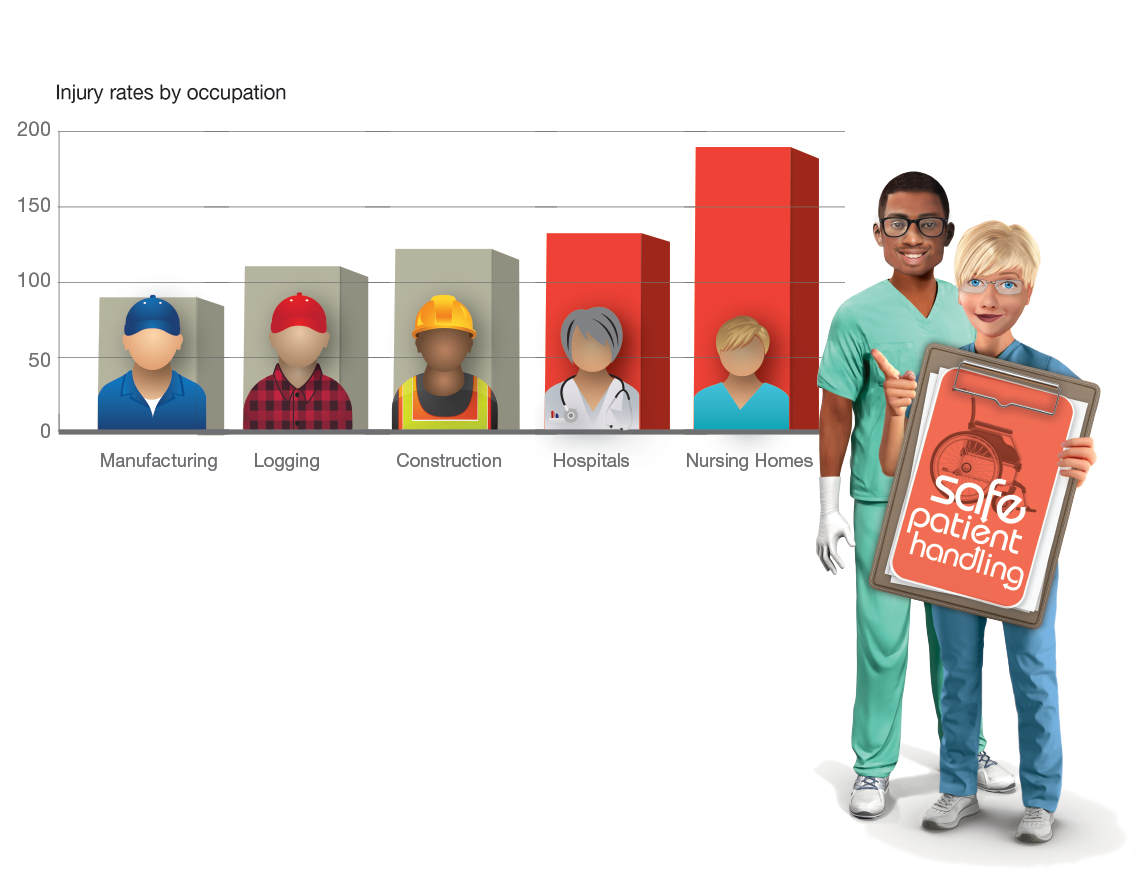
Although construction has a reputation as a high-risk industry, workers in hospitals and nursing homes have higher injury rates than workers in manufacturing, construction or logging.

See the chart below for the comparison of injury rates by occupation.

Who is being injured?

Injury rates by occupation, showing hospitals and nursing homes have higher injury rates than manufacturing, logging and construction

Source: Bureau of Labor Statistics 2017 incident rates for non-fatal injuries per 10,000 full-time workers.


How are health care workers being injured?

In its February 2018 Work Comp newsletter , the Minnesota Department of Labor and Industry reported on the sources of injuries in Minnesota hospitals in 2016:

  • Nearly 60 percent due to overexertion
  • Nearly 20 percent due to slips, trips and falls
  • Nearly 10 percent due to violence

Thirty percent of the injuries directly involved a hospital patient. Of those injuries involving a patient, the majority were due to overexertion while lifting or moving a patient.

The second most common cause was intentional or unintentional violence by the patient. Health care workers face some of the greatest risk for workplace violence. See our De-escalation Team Training – health care resource for information on de-escalation tactics in health care settings.

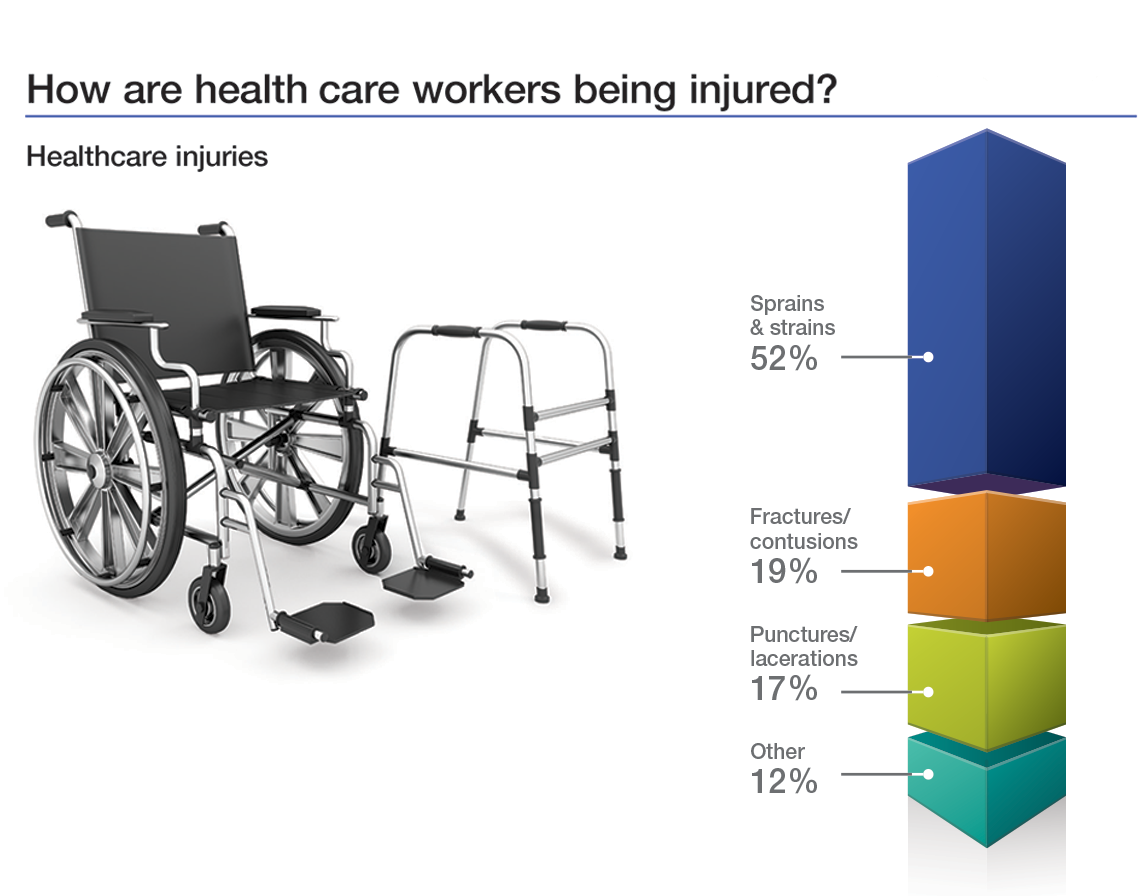
Strains and sprains account for more than half of all health care injuries reported to SFM. Many strain and sprain injuries occur while manually lifting and transferring patients. Fractures and contusions made up 19 percent of injuries, and punctures and lacerations were another 17 percent.

See the chart for the types of injuries sustained by health care workers.

How are health care workers being injured? Bar chart showing breakdown of injury types, with 52% sprains and strains, 19% fractures/contusions, 17% punctures/lacerations, and 12% other types of injuries


Source: SFM 2007-2016 health care policyholders claim data.


Some groups at more risk

Nursing home workers and other types of health care professionals have higher injury rates. Home health care workers face additional challenges due to their unique working environment.

Safety in health care faces another challenge due to an aging workforce. The U.S. Department of Labor reports that the average nurse is now older than 50 years old.

When health care workers over the age of 40 are injured, their claim is 76 percent more likely to be an expensive lost-time claim, where they are unable to return to work quickly. Older workers are at high risk for serious injuries due to lost muscle strength and other factors. Their more severe injuries and slower recovery times result in claim costs 2.4 times higher than for younger workers.

For more data and tips on how to reduce lifting injuries, download our occupational injuries in health care fact sheet .

What our safety pros keep in their winter emergency kits

We asked SFM’s loss prevention representatives what we’d find in the winter emergency kits they keep in their cars in case of roadside emergencies.

Their safety kits include:

  • Magnetized emergency flashers you can stick on the car
  • Fleece hats, scarves and mittens
  • Tow ropes
  • A blanket, such as a Mylar emergency blanket
  • First aid supplies
  • Hand and foot warmers
  • Matches and candles
  • A whistle
  • A flashlight and spare batteries
  • Warm boots
  • High visibility vest
  • Shovel
  • A lithium battery jump starter, which can also charge cell phones and provide light
  • Packaged snacks such as nuts and granola bars
  • A snow suit
  • Road flares and warning triangles
  • Chemical light sticks
  • Traction footwear

Follow these other winter driving safety tips for more advice.

Keeping problem employees on staff can increase workers’ compensation costs

Employees with poor performance often have more costly and challenging workers’ compensation claims than the average employee.

These typically are employees with:

  • Histories of attendance problems
  • Low productivity
  • Quality issues
  • Difficulty relating to others.

Many times, these employees should have been disciplined or even fired before they reported work injuries. But once a workers’ compensation claim has been filed, disciplining or firing an employee can become much more complicated, and costly.

For example, you may still be required to pay injured workers benefits for lost wages, even if you fire them. These wage-replacement benefits get expensive fast, ultimately impacting your workers’ compensation premium. If you’ve fired the employee, you no longer have access to an important tool to control these costs — offering light-duty transitional work.

In addition, it is not uncommon for an injured employee who is fired to sue an employer for retaliatory discharge.

What employers can do to prevent problems with poor performers

There are a number of things employers can do to avoid these types of challenges, including:

  • Deal with performance issues early. 
    This is the first and most important step you can take. This helps you avoid a situation where an employee has both ongoing performance problems and a workers’ compensation injury. The workers’ compensation claim undoubtedly will complicate your ability to manage this employee. Work with your supervisors to address performance situations. If termination is necessary, do it without delay to lessen the risk that it becomes entwined in the legalities of a workers’ compensation case.
  • Follow written policies and procedures. 
    Have a written and well-documented performance management plan that includes disciplinary steps to be taken in cases of misconduct. Follow your policy to the letter.
  • Document everything. 
    It can save you from expensive litigation. For example, document contacts with the employee, employee performance issues and remedial actions taken.
  • Think before you fire, especially when workers’ comp is involved. 
    You may be faced with a frustrating situation, but an impulsive decision could make the problem drag out longer and become more costly in the end. Discuss your options with your claims representative and your employment law attorney for assistance making the best business decision possible.

More information on dealing with problem employees

For more information on dealing with problem employees, see our:

This is not intended to serve as legal advice for individual fact-specific legal cases or as a legal basis for your employment practices.

Help your employees achieve the four elements of financial well-being

Money concerns aren’t usually something people like to talk about, especially at work.

So it may not be apparent to an employer when their employees experience financial stress. Yet recent data suggests financial stress is widespread. Employers can make an effort to recognize when money concerns affect their employees, so they can offer resources to help them move toward financial well-being.

The 2018 Employee Financial Wellness Survey by PwC reported that 53 percent of survey respondents feel financial stress.

The stress takes a toll on their focus and productivity at work. The same survey found that half of financially stressed workers took three or more hours of work time each week to deal with financial issues. Another 30 percent admit their productivity has suffered, and 16 percent occasionally miss work because of financial issues.

Financial stress could even lead to stress-related health issues, according to the Philadelphia Business Journal .

Signs of financial stress to look out for:

  • Requesting an advance on a paycheck
  • Being mentally distracted during work
  • Spending more time on phone calls
  • Showing up late or other attendance issues
  • Avoiding social occasions with co-workers, such as going out to lunch
  • Withdrawing money from a 401(k) early
  • Choosing not to participate in a retirement plan

Four elements of personal financial well-being

The opposite of financial stress, financial well-being, comes when people feel both secure about money and that they have the freedom to spend their money how they’d like.

The Consumer Financial Protection Bureau recommends that individuals review their financial well-being from four distinct perspectives.

People with high levels of financial well-being:

  1. Feel in control of daily and monthly finances
  2. Have the capacity to absorb a financial shock and have a safety net
  3. Have the flexibility to make choices about their finances
  4. Are on track to meet goals


Together, these four elements from the CFPB address someone’s financial security and freedom in the present and future.


In the present
In the future
Financial security
Feeling in control of daily and monthly finances
Capacity to absorb a financial shock, having a safety net
Financial freedom
Flexibility to make choices that represent their values and make them happy
On track to meet goals, setting and working toward goals that matter to them

Resources for your workplace financial wellness program

Developing resources to address financial stress requires knowing what stressors exist for your employees.

Jody Rogers, SFM Senior Vice President, Human Resources, recommends surveying employees about their needs and benefits.

“Even a small employer can put a survey together and hear what employees are asking for and what they need,” she says. “If you are tapped into and know what’s bothering your employees, and if financial stress is one of them, look into resources you can offer.”

Consider using your benefits broker to conduct an anonymous survey. Based on survey results, employers can tailor their financial wellness program to address the issues most common to their workforce, whether that’s budgeting and debt reduction or longer-term retirement savings plans.

According to the PwC survey, two of the most desired benefits employees sought were “access to unbiased counselors” and “help understanding and using their employer benefits.”

Rogers offers several strategies for building financial education into your benefits program, based on her extensive experience and what’s worked for SFM’s benefits program.

Components of a financial wellness program

Financial benefits or a financial wellness program could include any of the following:

  • Financial education – Inform new employees of all of the benefits available to them. Education could include group trainings on planning for retirement or an introduction to investing. It could also mean providing access to 1:1 financial counseling.
  • Retirement savings plans – According to the U.S. Census Bureau and Bloomberg , “Two-thirds of Americans don’t invest in their company retirement plan at all.” Make participating the default to increase employees’ long-term savings.

    SFM has designed the 401(k) plan to make it easy for employees to participate. Employees are automatically enrolled in SFM’s 401(k) plan and would need to take action to opt out, making participation the default. Employees may choose to automatically increase their contributions by 1 percent each year. SFM matches a portion of the investment as a further incentive. Combined, these techniques lead to a very high participation rate and make reaching savings goals effortless.

  • Student loan forgiveness – If your employees or potential employees have student loan debt or attend school while working, a benefit increasing in popularity is student loan repayment or tuition reimbursement. This benefit may give you an edge in a competitive job market.
  • Employee Assistance Program – Your Employee Assistance Program (EAP) might offer multiple resources, including referrals to a financial planner, and it’s all anonymous.
  • Reputable resources – Provide links to trustworthy sites for further information. Government programs include MyMoney.gov and the Consumer Financial Protection Bureau . For more on designing your workplace financial wellness program, visit Prosperity Now . Local nonprofits may offer financial counseling services.

Making financial benefits available to employees based on their needs shows you care. Employees can choose the benefits they want to build their financial well-being, for the present and the future.

This is not intended to serve as legal advice for individual fact-specific legal cases or as a legal basis for your employment practices.

Inexpensive safety solution: Replace old utility knives

Looking for an easy, inexpensive way to prevent injuries in your workplace? Consider replacing old manually retractable and fixed-blade utility knives with a concealed blade version.

They typically cost less than $3 a piece, and can prevent serious lacerations. As a side benefit, they also help prevent damage to the contents of boxes.

You can purchase these types of knives through Martor , Uline and many other retailers.

Safety video: Moves you can use to avoid winter slips and falls

When it’s snowy and icy outside, it takes the right moves to avoid a winter slip-and-fall injury in a parking lot. Show your employees this lighthearted video to remind them how to walk safely in slippery conditions.

Avoid winter slips and falls: Icy parking lot safety

For more winter prevention resources and information, visit SFM’s winter slip and fall prevention page.

How to develop a workplace severe weather policy

What do Midwesterners dread most about nasty winter weather? Driving in it.

Getting across town during a snow or ice storm can be stressful, time-consuming and dangerous.

What can you as an employer do to keep your employees safe and your organization functioning when dangerously bad weather hits?

There’s not always an easy answer, but the first step is to have a plan.

Why you need a severe winter weather policy

A severe weather policy is a critical component of your business’s overall emergency preparedness and disaster recovery plan.

It’s not uncommon for state departments of transportation to advise against travel due to severe weather. Whether it’s poor visibility or ice, unsafe road conditions could keep your employees from the office.

Schools have decades of experience in communicating closures to keep staff and students out of treacherous weather conditions. They’ve established clear plans on who makes the decision to close, by what time, and how to notify people.

But calling a snow day isn’t just for schools.

It’s essential for employers of all types to be prepared for a disruption to normal business operations because of severe weather. Of course, not everyone can shut down during inclement weather. Hospitals, for example, need to be staffed 24/7. You may have critical operations to keep running.

How can you get prepared? With a snow day policy.

Before the snow flies: Develop a snow day policy

The time to plan for bad weather is before a storm hits. Employees will have many questions that should be addressed in an inclement weather policy, like in this example policy .

“The inclement weather policy must set expectations, present a balanced approach to compensation, mitigate risks for both employers and employees, and present a fair solution for emergency situations,” writes Susan Heathfield .

Eight items to consider covering in your snow policy

Following are items you should think about covering in your inclement weather policy:

  • How you will communicate a closure to employees — phone call, text, email, broadcasting system, etc.
  • Your expectation that employees use caution while entering and leaving work in poor weather conditions
  • Your intention to monitor the weather forecast, as well as any specific conditions that will trigger a closure (snowfall amount, temperature, electrical outage, loss of heat, declaration of weather emergency, etc.)
  • Instructions that traveling employees are not to drive in unsafe conditions, as well as a reminder of your prohibition of cell phone use while driving
  • Expectations about what happens in the event of closure, such as whether employees should work from home
  • Compensation in the event of a severe weather scenario, keeping in mind local, state and federal laws
  • How you will notify customers, clients or vendors of a closure — notice on your website, voicemail message, email, etc.
  • The expectation in the event of a mid-day closure that employees are expected to leave immediately

Let’s look at a few of these items in more detail.

How to define a weather emergency

When developing your plan, consider setting specific criteria about the amount of snowfall, road conditions and temperatures that may trigger a closure. This will keep your employees from wondering about a snow day each time the snowplows come out.

Blizzards aren’t the only weather situation that may require closing. Below-freezing temperatures and wind chills as low as -60 degrees prompted the governor of Minnesota to close schools statewide in January of 2014.

Rely on an expert like the National Weather Service for weather conditions and to your state’s department of transportation for road conditions. You may look to your local school district as a guide. Know the terminology for different winter weather alerts, advisories and warnings.

Expectations for employees

If you’ve set up the ability for workers to telecommute or work remotely, do you still expect employees to work if your office is closed due to weather? What if the company does not close, but an employee would prefer to avoid traveling? Remote work options could allow them to avoid taking a personal day.

As with other parts of your snow day plan, communicate clear expectations with your employees if you expect them to work remotely if they cannot make it into the office. Prepare your IT infrastructure for a spike in activity if many more employees than normal try to access the remote work system.

Your weather emergency plan also needs to factor in maintaining any business-critical operations. If a vital employee cannot make it to work, do you have a backup plan?

Compensation

Keep in mind the business implications of voluntarily closing because of the weather. Even if your employees aren’t working, they may still be due a paycheck. Check your state and federal regulations for rules around paying exempt and non-exempt employees in various bad weather scenarios .

By developing a snow day policy ahead of time, you’ll be prepared to make a thoughtful decision before a storm hits, and you’ll help your employees stay safe.

Key: Be proactive and build a strong safety culture

An inclement weather policy can formalize your stance on employee safety during winter weather conditions, but ultimately, employees must also make decisions about their own safety and use their best judgment about whether they should be driving.

That’s why it’s important to foster a workplace culture where employees know you care about their health and safety and wouldn’t punish them for prioritizing their safety over work.

In the same vein, you can be proactive by starting to plan as soon as you hear a big storm is coming. You can encourage employees to rearrange their schedules in advance to avoid driving during the worst of it. This might mean leaving a day early to get to an out-of-town meeting, doing a delivery early or simply rescheduling an offsite meeting.

Strategies like this can keep your organization functioning while also keeping your employees safe.

This is not intended to serve as legal advice for individual fact-specific legal cases or as a legal basis for your employment practices.

This post was originally published on January 18, 2017 and updated on November 7, 2018.
css.php